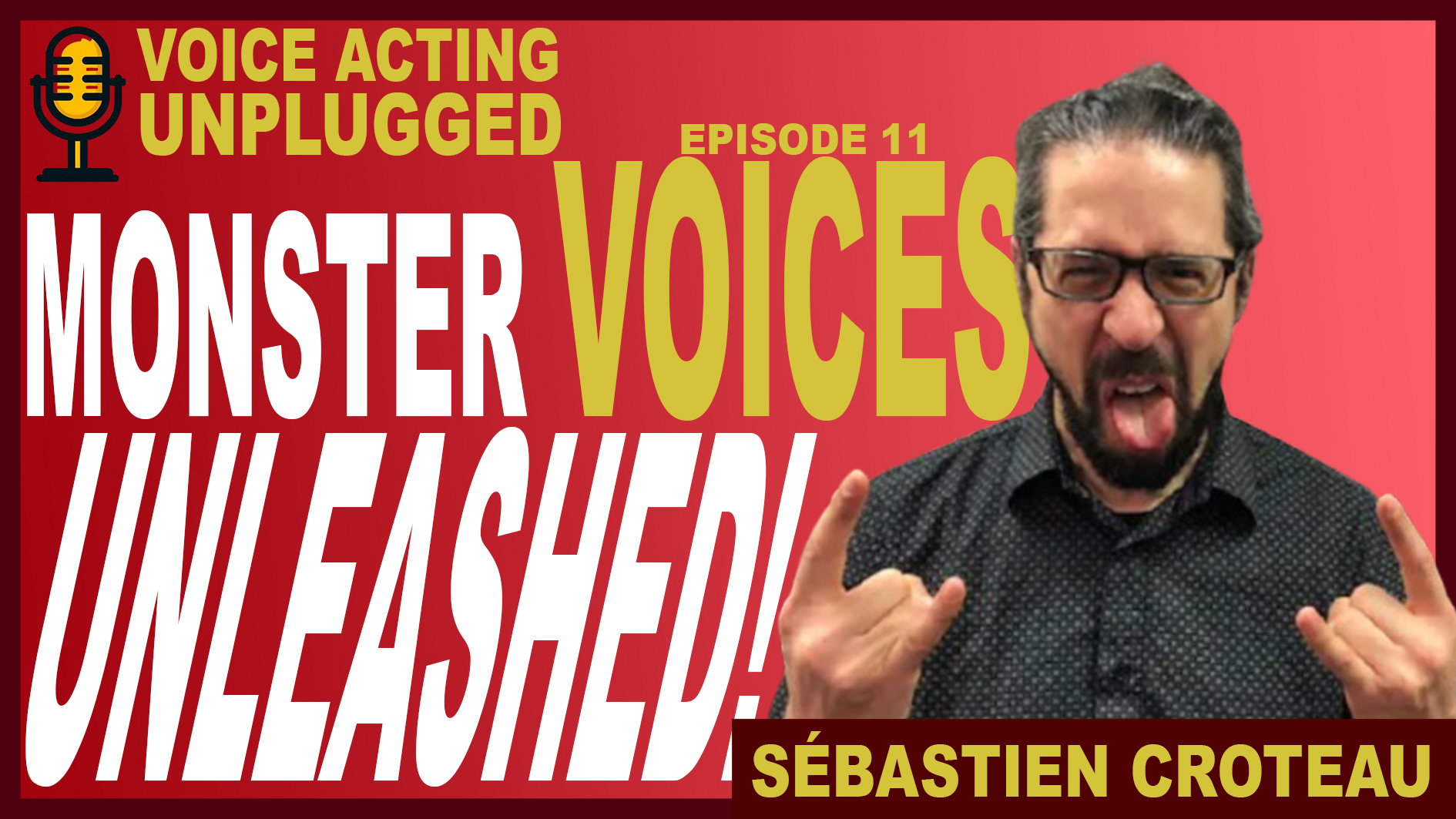

SEBASTIEN CROTEAU - Monster Voices Unleashed!
Watch on our YouTube Channel
Listen Now
Sebastien Croteau
Sébastien Croteau is a seasoned metal vocalist (Necrotic Mutation, since 1991) and accomplished throat singer, mastering Tibetan, Mongolian, and Inuit techniques since 1996. With over three decades of experience, he is widely recognized for his expertise in extreme vocal techniques, vocal effects, and vocal distortion.
For the past 15 years, Sébastien has been teaching metal vocals and throat singing, training hundreds of vocalists and voice talents across the globe. He is one of the rare vocal coaches certified in Vocal Distortion Teaching by New York Vocal Coaching, underlining his authority in the field. His deep knowledge of vocal distortion, extreme sounds, and creature vocalizations has made him a sought-after expert in both the voice acting and gaming industries.
In 2005, Sébastien began collaborating with video game studios, specializing in vocal stunt work and creature voice design. Since then, he has contributed to over 40 video games and films, including major titles such as Genshin Impact, Helldivers 2, The Outlast Trials, Until Dawn, Star Wars Outlaws, The Watchers, Hellblade 2, Baldur’s Gate 3, Warhammer: Realm of Ruins, Gotham Knights, Marvel’s Guardians of the Galaxy, Dead by Daylight, Dungeons and Dragons: Dark Alliance, Shadow of the Tomb Raider, Far Cry 5, Rainbow Six Siege: Outbreak, Prince of Persia – The Forgotten Sands, Assassin’s Creed 2, and many more. He has provided voices for over 300 characters.
In 2018, he founded The Monster Factory, a company and talent agency dedicated to extreme vocal performance, vocal stunt work, and creature voice design. Through this platform, Sébastien also serves as a casting director and voice director on a variety of projects, further solidifying his position as a leading figure in the world of vocal extremes.
SEBASTIEN CROTEAU - Monster Voices Unleashed!
Screaming for a Living: How Sébastien Croteau Built the World’s Most Unusual Voice Acting Niche
The death metal singer turned creature voice specialist on Tibetan throat singing, why zombies don’t have backstories, and the case for treating monster vocalists like the stunt performers they are.
There are voice actors who specialise in corporate narration. There are voice actors who specialise in audiobooks, or commercials, or video games. And then there’s Sébastien Croteau, who gets paid to scream, growl, choke, and howl — and has been doing it for eighteen years across more than 400 titles.
As the founder of The Monster Factory, a company that provides creature and monster vocalisation for the video game, film, and animation industries, the French Canadian performer occupies what is arguably the most unusual niche in the entire voiceover world. His team of nearly eighty “vocal stunt performers” around the globe creates the sounds that most people never think about but instantly recognise: the guttural roar of an orc, the clicking menace of a giant spider, the choking death rattle of a poisoned guard in Assassin’s Creed.
In a recent episode of Voice Acting Unplugged, the podcast hosted by Margaret Ashley and Anthony Rudd, Croteau joined to share his extraordinary journey from death metal vocalist to creature voice pioneer, explain the vocal mechanics behind the sounds he produces, and offer his characteristically measured take on AI in an industry where animal sound libraries and voice-modifying plugins have been the norm long before artificial intelligence entered the conversation.
What followed was one of the most fascinating — and frequently startling — conversations the podcast has produced.
A Wonderful Accident
Sébastien Croteau’s path into creature vocalisation began, as he put it, as “a wonderful accident” — though one with roots stretching back to 1991, when he first started performing as a death metal vocalist with his band Necrotic Mutation.
For years, extreme metal vocals were enough. But eventually, Croteau found himself wanting to explore what else his voice could do. The answer came from an unexpected direction: Tibetan throat singing.
“I heard Tibetan throat singing, Tuvan throat singing, Mongolian throat singing, and Inuit throat singing,” he said. “And I was immediately interested in their capacity to produce the sounds they were producing.”
He was fortunate enough to find one of the rare Tibetan throat singing teachers in Montreal, and learned the technique quickly enough to become the teacher’s assistant. Together, they organised the first throat singing festival in Montreal, bringing in Tibetan monks, Tuvan singers, and world-renowned specialists including Steve Sklar and Tran Quang Hai.
For anyone unfamiliar with these traditions, Croteau offered a brief — and spine-tingling — live demonstration during the podcast, shifting between the deep, resonant tones of Tibetan throat singing and the higher, almost whistling overtones of Tuvan technique. The sounds are produced using ventricular folds — mucus membranes located just above the vocal folds — which vibrate at two to three times less the frequency of the vocal folds themselves, generating sub-harmonics that sit an entire octave below the note actually being sung.
“If I do this,” Croteau said, producing a clear tone, “that’s the note I’m actually singing. But this” — and his voice plummeted into something that seemed to come from beneath the floor — “is a sub-harmonic. Because I’m activating the ventricular folds.”
It’s the kind of vocal demonstration that’s difficult to convey in text and impossible to forget in person. And it was this extraordinary toolkit — death metal screaming combined with throat singing techniques from multiple traditions — that would eventually lead to a career nobody had quite imagined before.
The Call from Ubisoft
In 2005, a friend of Croteau’s named Alexan began working at Ubisoft Montreal. The studio was looking for something unusual: someone who could produce creature and monster sounds for a game called Far Cry Instinct. Alexan knew exactly who to call.
“He was like, ‘Yeah, I know a guy who can do weird voices — you should contact him,'” Croteau recalled.
The audio director invited Croteau to Ubisoft’s Montreal office and showed him sketches of the various monsters and creatures in the game. Croteau offered suggestions for what vocal approach might suit each one. Then he went home.
And heard nothing for eight months.
“I thought I’d blown it,” he said. “But I wasn’t aware back then of the time it takes to actually produce a video game.”
When the call finally came, Croteau approached it with the confidence — and the stamina expectations — of a death metal performer. He booked himself for eight hours of screaming per day, across two days.
“It was quick for me to realise that eight hours of screaming was too much,” he said.
But the work got done, and it led to more. Ubisoft called him back to provide the choking death sounds for Assassin’s Creed II — “when you poison people with a poison blade and the person is choking in their mucus, that’s my voice.” Then came Prince of Persia. Then other Montreal-based studios began hearing about the metal vocalist who could voice their creatures and monsters.
As the demand grew, so did the need for variety. Not every creature needed Croteau’s particular vocal quality — there were female characters, different tonal ranges, different types of monsters. He began bringing in other metal vocalists he knew in Montreal, friends whose voices offered different textures and capabilities.
“The team that we have now was built up over years of just introducing people,” he said.
The Monster Factory Is Born
For eighteen years, Croteau provided creature and monster vocalisation as a freelancer alongside his day job. But in 2021, a health crisis forced a reckoning.
During the pandemic, Croteau wasn’t struck by COVID but by the consequences of workplace stress. His previous employer had laid off significant numbers of staff, and those who remained were expected to absorb the additional workload. Croteau developed stomach ulcers and other stress-related conditions that kept him off work for six months.
When it was time to return, his employer wanted him back full-time immediately. His doctor disagreed. And Croteau found himself at a crossroads.
“I was like, okay — I’m going to go back to a job that might make me sick again, or take a leap of faith and try to make this work,” he said. “I’m forty-nine now, so I have a more limited window of time to make it work.”
He recalled hearing Elvis Presley’s “It’s Now or Never” at the moment he made his decision. The symbolism wasn’t lost on him.
“Of course, it’s a lot of sacrifice,” he said. “I quit a well-paid job for financial insecurity, which is the case of most people working in voiceover anyway.”
The Monster Factory was born — and it now provides creature and monster vocalisation for games, films, and animation worldwide, with a team of close to eighty voice talent across multiple countries. When localisation is required — because yes, some monsters do have scripted dialogue — Croteau can draw on performers in the appropriate languages.
Do Monsters Have Backstories?
One of the most illuminating parts of the conversation was Croteau’s explanation of how creature voice acting differs fundamentally from traditional character work — and why much of the standard voice acting methodology simply doesn’t apply.
He illustrated the point with a vivid thought experiment.
“Let’s say you’re a human character in a zombie apocalypse,” he said. “You’re a young adult. You saw your parents die when you were a kid. You had to kill some loved ones who turned zombie. All those elements would impact your personality — this is the kind of background information you’d use to build a character.”
He paused.
“If that person is bitten and becomes a zombie, do you think it’s going to be the sad zombie? The melancholic zombie? No. It just wants to eat your brain. Those elements no longer apply.”
The same principle holds for the vast majority of creature work. A spider that communicates through clicking sounds isn’t going to be influenced by a detailed character biography. A dog, a generic monster, an alien predator — their vocal identities are driven by physical characteristics, movement patterns, and what Croteau calls “vocal archetypes” rather than psychological backstories.
“If I have to voice a spider and the vocal effect is a clicky sound, even if you tell me the whole story of that species, it’s not going to influence a lot of the sound I’m producing,” he said.
The exceptions are creatures with intelligence and scripted dialogue — orcs, trolls, certain aliens. There, the character background becomes relevant because the creature is effectively a character in the traditional sense, just one that happens to communicate through an extreme vocal register.
“All those background elements can have an influence when there’s actual script lines,” Croteau acknowledged. “But when it’s a dog, an animal, or other kinds of creature, the background information that would be useful for a human character is just not that useful.”
The Evolution of the Zombie Voice: A Brief History
Croteau offered a fascinating mini-lecture on how zombie vocalisations have evolved across decades of film and gaming — a trajectory that reveals how creative needs drive vocal innovation.
It began with silence. In the early black-and-white era of voodoo zombies, the creatures were largely mute. George Romero’s Night of the Living Dead introduced the iconic moan — low, directionless, unsettling. Day of the Dead built on this with the character of Bub, a zombie showing flickers of residual humanity, whose vocalisations carried a haunting quality that Croteau clearly adores (he owns a T-shirt with Bub’s face on it).
The Resident Evil games on PlayStation continued in the moaning tradition. But then came a seismic shift: Danny Boyle’s 28 Days Later and Zack Snyder’s Dawn of the Dead remake introduced running infected and running zombies, respectively.
“A running zombie doing ‘Ooooh’ — it’s not working,” Croteau said, mimicking the mismatch between a slow, ponderous moan and a sprinting, rage-filled creature.
The solution was a shift toward something far more aggressive — screaming, snarling, guttural attacks. The vocal archetype for zombies had to evolve because the physical reality of the character had changed. You can’t sprint at someone while moaning gently.
It’s a small example that illustrates a larger truth about creature vocalisation: the sounds aren’t arbitrary. They’re driven by the physical design, movement, and narrative context of the creature, and they’ve evolved over time as those contexts have changed.
We All Have the Same Parts
One of the most reassuring — and perhaps surprising — things Croteau shared was that the ability to produce extreme vocal effects isn’t a genetic gift. It’s a skill.
“One of the big myths people ask me about is: am I a mutant?” he said. “Do I have extra parts in my vocal tract that allow me to create those sounds? The answer is no.”
Apart from people who’ve had surgery — one of his friends had his uvula removed, making uvula vibration impossible — every human being has the same vocal anatomy. Ventricular folds, aryepiglottic folds, vocal folds, the soft palate — the parts are universal. There may be minor individual variations in thickness or prominence, but nothing that fundamentally changes what’s possible.
“The capacity to produce those sounds is within everyone,” Croteau said.
He pointed to the most basic evidence: babies. From birth, human beings are capable of producing vocal distortion. Screaming is innate. It’s only through the process of language acquisition and social conditioning — parents telling children to be quiet — that we lose touch with those capabilities.
“After being able to scream, we are told not to,” Croteau said. “So of course there’s a whole process to get back to it.”
That process, however, takes years. Like any athletic discipline, creature vocalisation requires sustained, deliberate training — not just to produce the sounds, but to sustain them safely over the kind of sessions that the industry demands.
Vocal Stunt Performance: The Term That Reframes Everything
Croteau has a specific term for what he and his team do, and it’s one he’s chosen deliberately: “vocal stunt performance.”
The analogy is drawn from the film industry. In movies, highly specialised stunt performers are hired to do things that actors can’t safely do themselves — falls, fights, car chases. No reasonable production would ask an untrained actor to perform a dangerous physical stunt (Tom Cruise, Croteau noted with a laugh, being the single exception).
And yet in voice acting, untrained performers are routinely asked to scream, roar, and produce extreme vocal effects for hours at a time.
“Unfortunately, in voice acting, we are asking voiceover talent who are not trained properly to produce those sounds,” Croteau said. “If we think about stunt performance in movies, I think we are doing the equivalent in voice acting. This is why I call what we do vocal stunt performance.”
The implication is clear: only trained vocal stunt performers should be doing vocal stunt work. The consequences of getting it wrong aren’t just a bad take — they’re potential vocal damage that can end careers.
“As you can hear, I’ve been screaming and producing these sounds for thirty-five years now,” Croteau said. “Does my voice sound damaged? No. There’s a way to sustain that, but it’s hard work.”
AI in the Monster World: It’s Already Here
On the question of artificial intelligence, Croteau brought a perspective that was uniquely informed by the realities of his niche — and significantly different from the anxiety that dominates most voiceover industry discussions.
The reason? In creature and monster vocalisation, AI isn’t the primary threat. The market was already dominated by non-human alternatives long before AI entered the picture.
“The reality of the creature voice acting market is that the vast majority of sounds for creatures and monsters are done with animal sound libraries or software that modifies the voice in real time,” Croteau explained. “If you listen to any Hollywood blockbuster, there’s a villain with a huge voice — that’s plugins. It’s already a market dominated by animal libraries and plugins.”
He estimated that less than one percent of creature and monster sounds in major games and films are produced by human performers. The Monster Factory exists to prove that human voices can do the job better — but the competitive landscape was already tilted toward technology before AI arrived.
“AI software could do exactly the same as the plugins that already exist,” Croteau said. “So the market is already taken over. What I’m trying to do is prove that human beings are actually better.”
As for whether AI companies are likely to target the creature vocalisation niche specifically, Croteau was sanguine.
“If you look at AI companies, what they are mainly targeting is regular voiceover jobs, because that’s where the money is for them,” he said. “The money is not in a tiny market of less than one percent. This is why I’m not worried about it for the moment.”
Consent, Control, Compensation
Where Croteau’s AI perspective became most interesting — and most likely to provoke debate — was in his broader philosophical stance. Unlike many in the voiceover community who advocate for outright resistance to AI voice technology, Croteau takes a more pragmatic position.
“For me, the whole thing about AI boils down to three things,” he said. “Are you consenting? Do you still have control over what it’s going to be used for? And are you being compensated?”
If those three conditions are met, he argued, AI could potentially open new possibilities for voice talent rather than simply threatening them.
“I might be crucified for this,” he acknowledged, “but I’m not on the side of ‘burn it with fire.'”
His reasoning is strategic rather than ideological. AI technology is already here and already being used. Companies are going to develop it regardless of whether voice actors engage with the process. The question, in Croteau’s view, is whether voice talent participates in shaping how it’s developed — or stands on the sidelines while it’s built without their input.
“If you tell those companies, ‘We don’t need you, burn it,’ they’re going to go, ‘Okay, we’ll build our stuff without their input,'” he said. “And this is why, for me, you either try to influence the model towards something that is sustainable for voice talent, or you remain on the side of ‘burn it with fire’ — and therefore they’re not going to hear what you have to say.”
He was quick to acknowledge the legitimate grievances. Companies scraping voice data without consent, requiring full 3D scans just to audition, building AI models from performers’ work without permission or payment — all of this, Croteau said plainly, is “the dumb stuff.”
“When I said consent, control, and compensation are key — when you look at the negotiation that SAG-AFTRA did with one company in the States, it’s all about putting a legal framework around the usage of AI,” he said. “It’s a first framework that we can build off. But of course, some people are abusing it. That is dumb. You don’t do that.”
His position is nuanced enough to sit uncomfortably with people on both sides of the debate — which may be a sign that it’s closer to the truth than the more polarised positions.
Training the Next Generation of Monsters
For the growing number of voice actors and aspiring performers interested in creature vocalisation — many of whom, Croteau noted, are congregating on Discord and Reddit — his advice begins and ends with training.
“The number one thing is learning how to activate the different parts that we use in creating monster and creature voice,” he said. “And the second thing, which is equally huge, is the capacity to sustain those vocal effects for a long period of time.”
In professional AAA game production, recording sessions run a minimum of two hours. That means maintaining a specific vocal effect — a particular growl, rasp, or scream — consistently and safely for two hours straight. If you can produce the sound for thirty seconds but lose it after a minute, you don’t have a usable skill.
“If you can no longer sustain that vocal effect, you lose the character,” Croteau said. “That’s it. The vocal effect is part of the character’s identity. It’s intimately tied to who that creature is.”
He pushed back firmly against the assumption that creature vocalisation is simply “noises.”
“Sometimes I see people say, ‘I don’t have a creature voice reel, but I can do noises.’ If your understanding of creature vocalisation is that it’s just noises, you’re missing the point.”
The Monster Factory offers training through multiple channels. Croteau has delivered over fifty workshops in the past three years, including sessions at OMUK in London with Mark Eastdale and voice therapist Karen Esposito, as well as through Skills Hub, the App Network, and Real Voice LA. His approach mirrors that of a sports coach: before any training begins, he conducts a vocal assessment to understand what each individual is already capable of and what their goals are.
“If I was a coach and I wanted to train an athlete to go to the Olympics, but I had no idea what they were capable of, could I build an accurate, custom-made training programme?” he said. “No. A good coach does a physical assessment and builds a training programme accordingly. I have the same approach for creature voices and vocal stunt work.”
The training path is long — years, not weeks. But Croteau believes it represents a genuine competitive advantage for voice actors willing to put in the work.
“Creature voice acting can be one of those things that other people don’t have that might give you an edge,” he said.
The Future: Diversify or Die (Metaphorically)
When asked where the creature vocalisation niche — and the broader voiceover industry — is heading, Croteau’s answer combined optimism with hard-headed realism.
The optimism came from a simple observation: every form of live human performance that has ever existed has survived the arrival of new technology. Theatre survived cinema. Live concerts survived recorded music. The human appetite for authentic, embodied performance is deep and durable.
“We’re still doing theatre despite the fact that we have TV and cinema,” Croteau said. “People still go to concerts because that’s where it’s happening — we see people live. There will always be a place for human beings.”
The realism came from his insistence that survival requires diversification. The Monster Factory itself is a testament to this philosophy: Croteau doesn’t just perform creature voices. He teaches, directs, records, designs sounds, gives conference talks, and runs a global network of vocal stunt performers.
“I have to do a whole bunch of things to make it work,” he said. “I do believe that in order to adapt to what is coming — all the modifications that we still don’t know a lot about — people need to be able to diversify what they’re doing.”
It’s advice that applies well beyond the creature niche. In an industry facing simultaneous disruption from AI, changing client expectations, and shifting media formats, the performers and businesses most likely to thrive are those with the widest range of skills and the deepest commitment to their craft.
Or, as Croteau put it with characteristic good humour when contemplating his eventual demise: “If heaven and hell exist, I’m going to be a vocal coach in hell, training people how to scream properly.”
This blog post is based on an episode of Voice Acting Unplugged, hosted by Margaret Ashley and Anthony Rudd. To learn more about Sébastien Croteau, The Monster Factory, and creature vocalisation training opportunities, visit themonsterfactory.com. For more episodes of the podcast, subscribe and follow Voice Acting Unplugged on your preferred platform.
Join Margaret & Anthony next time on Voice Acting Unplugged.