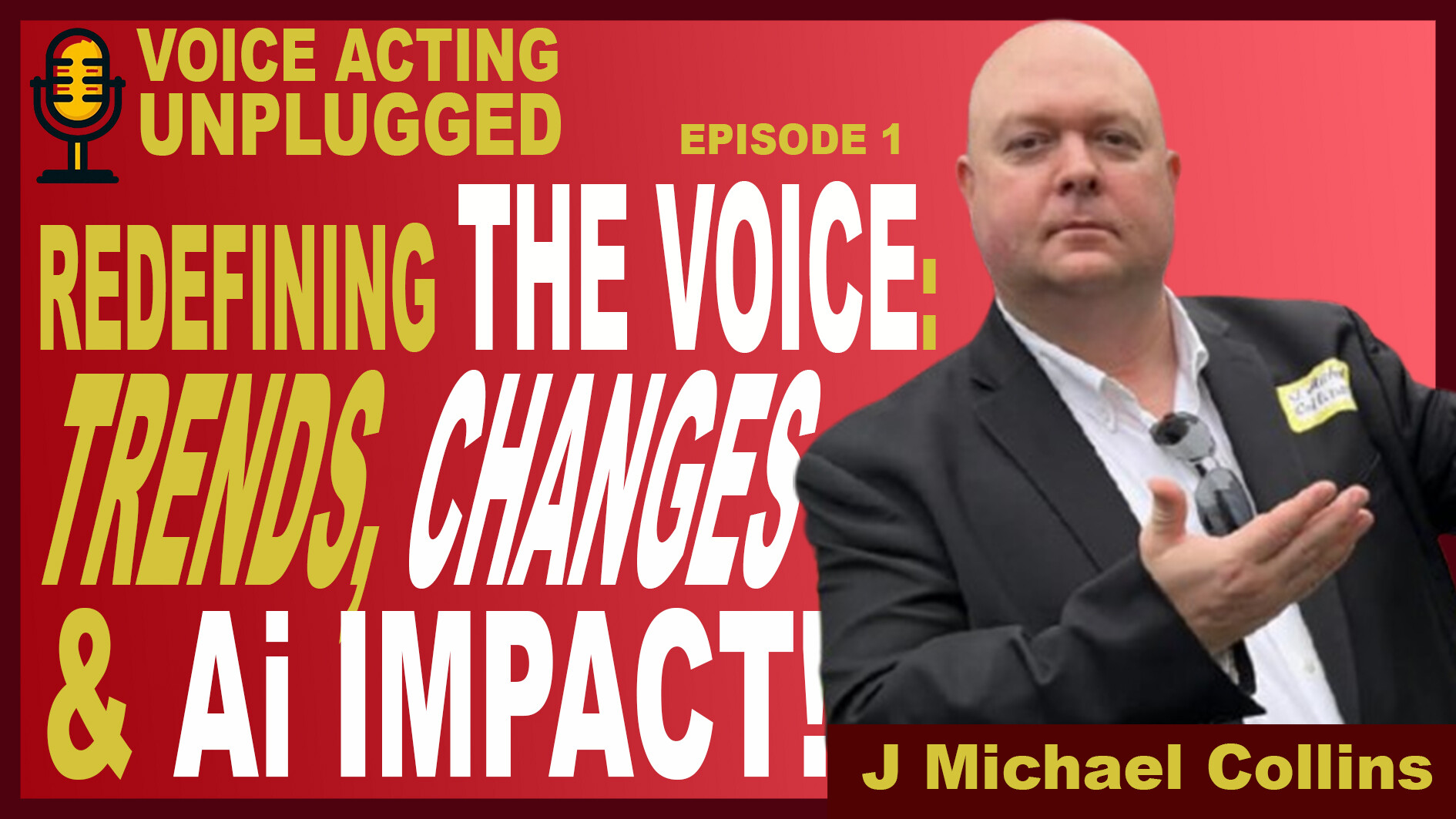
J MICHAEL COLLINS – Unplugged

blank
blank

J MICHAEL COLLINS - Redefining the Voice

Watch on our YouTube Channel

Listen Now

J. Michael Collins

With over 25 years of experience as a professional voice actor, J. Michael Collins has collaborated with some of the world’s most prominent companies, brands, sports leagues, and organizations. Beyond his success in traditional, agency-driven voiceover work, he has become a respected authority in the online casting space and is widely recognized as a top-tier voiceover coach and demo producer.

J. Michael’s contributions to the industry have earned him more than 50 awards across categories including voice acting, demo production, scriptwriting, and casting direction. Together with his wife and business partner, Anna, he produces VO Atlanta—the industry’s largest and longest-running conference—as well as co-produces the One Voice Conference USA. Each year, they also host elite voice actors at luxurious European destinations for the renowned JMC Euro VO Retreats.

J MICHAEL COLLINS - Redefining the Voice

Inside the Voice Acting Industry: J Michael Collins on Trends, AI, and the Future of Voiceover

A Conversation with One of Voiceover’s Most Influential Figures Reveals Where the Industry Is Headed in 2025 and Beyond


When J Michael Collins talks, the voiceover industry listens — and not just because of his award-winning voice. With over 25 years as a professional voice actor, more than 50 industry awards, and a client roster that reads like a Fortune 500 directory, Collins has earned his reputation as one of the leading authorities in the business. As producer of VO Atlanta (the industry’s largest and longest-running conference), co-producer of One Voice Conference USA, and host of the acclaimed JMC Euro VO Retreats, he sits at the intersection of performance, business strategy, and industry leadership.

In a recent conversation on Voice Acting Unplugged with hosts Margaret Ashley and Anthony Rudd, Collins shared candid insights on everything from political voiceover and AI to the future of casting trends and what it really takes to build a sustainable career in voice acting. Here are the key takeaways.


From Radio Booth to Voiceover Behemoth

Collins’ origin story is the stuff of industry legend, but even the CliffsNotes version is compelling. He started in radio broadcasting at 15 years old, and within six months, station sponsors were hiring him to voice their commercials. Suddenly, a teenager was pulling in a couple thousand dollars a month doing commercial voiceover — taking dates to baseball games and nice restaurants, and thinking, “Wait a minute. This is interesting.”

By the time he graduated university, Collins was making a small but legitimate living in voiceover. He turned down law school to pursue it full-time. His family thought he was insane. It turned out to be, in his understated words, “an okay decision.”


The Political Voiceover Boom: Why It’s Not Slowing Down

Political voiceover is a massive — and massively lucrative — sector of the US market, one that barely exists in the UK. Historically, it followed a predictable cycle: election years surged, off-years dropped by roughly 60 percent.

Then came the Trump era.

“Since the dawn of Trump, when he first came down the escalator, it went up every year in terms of volume,” Collins explained. Even in off-cycle years, the pullback shrank dramatically — from a typical 60 percent drop to roughly 30 percent.

With Trump’s most recent election win, Collins says there’s virtually no slowdown in sight. The day after the 2024 election, he was hired to voice 10 commercials attacking Elon Musk. The work simply pivots from campaign advertising to issue-based advertising, with both sides of the political spectrum running ads year-round. Campaign advertising will ramp back up by summer and early fall for the 2026 midterm cycle.

For voice actors working in this space, the message is clear: political voiceover is no longer seasonal — it’s perennial.


British Voices in the American Market: Opportunity and Ceiling

For UK voice actors eyeing the US market, Collins offered a balanced and practical assessment.

There is absolutely a market for British voices in America, particularly in commercial work and non-broadcast narration. The pattern is straightforward: British voices tend to get hired for British products, luxury or premium brands, and internationally facing content. If a US-based company is distributing e-learning, corporate narration, or medical content to a global audience, a British accent can be the preferred choice — even when the buyer is American.

However, Collins was honest about the ceiling. “Unless you’re David Attenborough or one of a handful of people who get very lucky, there’s a little bit of a ceiling in the US market for UK talent,” he said. “I wouldn’t expect to get too far out of five figures.” But making a decent supplementary income is absolutely attainable — just as Collins himself earns a reliable annual income voicing quintessentially American brands (NBA, Heinz, KFC) for UK campaigns.

For British voice actors looking to break in, Collins recommended an “all of the above” approach:

  • Top-tier talent agencies (CESD, SBV, DPN, Atlas, and others) will yield the best auditions for major commercial, documentary, and promo work.
  • Direct marketing to production companies and ad agencies can be effective because they typically don’t have many British voices on their roster.
  • Online casting platforms can work without requiring the expensive premium tiers, since competition from other UK voices is naturally lower.

The good news? British talent may actually have an easier time getting on agency rosters than American talent, simply because there are fewer of them competing for those spots.


Advice for New Voice Actors: Realistic Expectations and Proper Preparation

Collins didn’t sugarcoat the realities of starting a voiceover career.

“There’s a mythology out there of the market being oversaturated with talent. It really isn’t,” he said. “But the market is oversaturated with people calling themselves talent.”

The numbers tell the story: in North America, roughly 200,000 people call themselves professional voice actors. Of those, perhaps 10,000 earn anything the IRS would care about. And of those 10,000, about 2,000 book most of the work.

That’s actually encouraging news for those willing to do the work properly. If you can deliver quality audio, understand performance, and compete consistently, the field is far less crowded than it appears.

But Collins was equally direct about financial expectations. “Very few people get rich or even upper middle class in voiceover,” he noted. For most successful US voice actors who do everything right, annual earnings settle around $50,000 to $60,000. Some go on to deep six- or even seven-figure careers, but they are the exception.

His core advice for newcomers:

  1. Have realistic expectations. This is a small business, not a lottery ticket.
  2. Don’t compete until you’re ready. Get proper training, build a professional home studio, invest in quality demo reels, and create a solid website.
  3. A bad demo closes doors for a long time. You only get one chance to make a first impression.
  4. Avoid the “weekend workshop to demo” pipeline. Don’t pay $500 for a weekend course that promises you a demo and immediate bookings. It doesn’t work that way.

The US vs. UK Market: Trends Trickle Across the Atlantic

One of Collins’ most fascinating observations is how voice acting trends migrate between markets. American trends, he says, tend to trickle into the Canadian market about three years later — and into the UK market about seven years later.

The US began embracing more diverse, younger, and less polished voices around 15 years ago. The UK started moving away from Received Pronunciation (RP) roughly eight to ten years ago — right on schedule. Today, UK listeners hear far more estuary and regional voices, reflecting the same “real and authentic” movement that transformed American voiceover half a decade earlier.

But here’s the twist: the US market is now showing signs of a pendulum swing. After seven to ten years of young, hip, chatty, and conversational reads, American casting has begun pivoting back toward more polished, assertive, classical voices.

“It’s been seven, eight, ten years of young, hip, real, quirky, cute, chatty,” Collins observed. “And now the market is starting to hear that and saying, ‘We’ve heard that a lot,’ and it’s starting to hit the ear the same way the announcer voice did.”

For voice actors on both sides of the Atlantic, the lesson is clear: the market is always moving. Versatility and awareness of shifting trends are essential.


AI: Less Scary Than You Think (For Now)

The elephant in the room — artificial intelligence — came up, as it inevitably does in any conversation about voiceover’s future. But Collins’ perspective may surprise those who’ve been sounding the alarm.

“I was a lot more worried about it a couple of years ago than I am today,” he admitted.

His reasoning is data-driven. AI hasn’t had the impact he expected, even on the lower end of the market where he anticipated the most disruption. While it’s “nibbling around the edges,” the overall voiceover market continues to grow. More media is being produced than ever before, which means more demand for voice talent. Whatever work AI is absorbing isn’t keeping pace with the industry’s overall expansion.

Collins sees AI as an almost parallel industry rather than a direct competitor. High-end buyers — the creatives at agencies and production companies — show almost zero interest in replacing human talent with AI. They value the creative collaboration, they aren’t budget-sensitive in that way, and they simply prefer working with people.

He shared a telling anecdote: a client hired him for a video for the Cannes Film Festival and sent him an AI-generated scratch track that was, Collins admitted, “pretty good.” When he asked the client why he didn’t just use the AI version, the French producer was horrified. “Are you kidding me? They would kill me if they knew I used AI when they’ve spent $500,000 on this production.”

Collins’ bottom line on AI: “AI can only ever be as good as we are. It can never be better than we are.” It lacks soul, it can’t truly be art, and just because the technology exists doesn’t mean there’s a market for it in creative contexts. The work AI is taking, he argues, “was not our work to begin with” — it’s serving buyers who never had the budget for professional voice talent in the first place.


The Real Value of Voiceover Conferences

As the producer of VO Atlanta and co-producer of One Voice Conference USA, Collins is obviously biased on this topic — and he’s the first to say so. But his insight into why conferences matter goes beyond the obvious.

“The biggest value of the conferences is not necessarily the content,” he said — a refreshingly honest admission from a conference owner. While the sessions, panels, and face time with agents and casting directors are valuable, the real magic happens in the margins.

The truth is: voice actors hire each other constantly. Collins himself casts different voices for his own clients roughly twice a week, and he almost always hires people he’s sat down with, shared a meal with, had a laugh with — people he’s met in person, not just over Zoom.

“Sometimes the magic at conferences happens at the lunch table. It happens between the sessions. It happens at the karaoke night,” he said. Building your “tribe” — whether that’s 8 people or 80 — creates a network that takes care of its own, organically and authentically.

His advice: don’t go in with a cynical networking mindset. Go in to connect genuinely. You’ll be surprised how naturally the work follows.


2025 Casting Trends: The Year Without an “It” Voice

Perhaps the most exciting prediction Collins shared is about where casting is headed in 2025.

For the first time in a long time, he believes the US market won’t have an “it” voice — no single demographic, age range, or style that dominates. Instead, he’s seeing a diversification of casting choices:

  • More assertive reads are making a comeback
  • Slightly older voices are being sought
  • Regional and unexpected choices are showing up in mainstream campaigns (including Southern voices for brands like Microsoft Copilot)
  • More curated, targeted casting with initial rounds of 20 people instead of 500

“This may be the first year in a long time in the US market where, as long as you’re good at what you do, the work that is meant to find you is going to find you,” Collins said.

For voice actors who’ve felt boxed out by narrow casting trends, this could be a watershed moment — a year where quality and authenticity matter more than fitting a particular mold.


The JMC Euro VO Retreats: Where Careers Transform

Collins also pulled back the curtain on his acclaimed European retreats — week-long, all-inclusive learning experiences held at five-star venues in locations like Dublin, Holland, and Florence.

The format is intimate by design: roughly 20 voice actors, seven or eight presenters (top agents, casting directors, managers, and elite talent), and three daily blocks of two-and-a-half-hour sessions from Tuesday through Friday. By week’s end, attendees might find themselves in a session with just two or three other people and a major agent from CESD or DPN — an intimacy impossible to achieve at larger conferences.

But the retreats have evolved beyond pure education. Collins described them as experiences of “psychological release,” where attendees can be themselves in front of people they’d normally find intimidating. The result is something he and Anna didn’t fully anticipate when they started: a profoundly meaningful, even emotional experience.

“There was an element of psychological release at these things where you’re allowed to be yourself in front of people that you would often normally be intimidated by,” he said. “And they relax, and you realize they’re human beings just like you.”

The retreats have attracted increasingly accomplished talent — from healthy five-figure earners looking to level up, to voice actors already making $200,000-$300,000 annually who want to reach the elite tier. They sell out quickly (sometimes in two days), and a growing number of “frequent flyers” return year after year.

The 2025 retreats in Holland and Florence are already sold out, but a spring 2026 venue will be announced shortly after VO Atlanta in early April. Watch Collins’ social media for the announcement.


The One Tip Every Voice Actor Needs to Hear

When asked for a single piece of advice, Collins’ answer was characteristically direct:

“Honor the business.”

“Do it the right way in terms of building your career. This business is an inch-by-inch business, not leaps and bounds and miles for most people,” he said. “You always hear the stories of people who jump in and go from zero to wow in a year — but the reason they’re stories is because they’re the exceptional ones.”

His formula is simple but demanding: trust the process, be smart, be methodical, be prepared. Treat voiceover as the craft it is. Understand that you’re competing against serious professionals who have invested years in honing their skills. And when you step onto the field of play, make sure you’re ready.

“You’re probably not going to get rich,” Collins concluded. “But you’re also probably not going to go hungry if you take your time to do it the right way.”


J Michael Collins can be found on social media and at jmichaelcollins.com. VO Atlanta, the industry’s largest voiceover conference, takes place annually in early April. For updates on upcoming JMC Euro VO Retreats, follow J Michael and Anna Collins on their social channels.

This blog post is based on an episode of Voice Acting Unplugged, hosted by Margaret Ashley and Anthony Rudd.

Join Margaret & Anthony next time on Voice Acting Unplugged.

Trish Bertram – VAU

blank

TRISH BERTRAM – Olympic Voice of God

Watch on our YouTube Channel

Listen Now

Trish Bertram

Trish is a seasoned voiceover artist with extensive experience across a wide range of formats, including documentaries, web and corporate narration, TV promos, radio imaging, and commercials. She has also served as a live announcer for television broadcasts, major events, and award ceremonies.

In 2012, Trish’s voice was heard around the globe as the Live Stadium Announcer for the London 2012 Olympic and Paralympic Games Ceremonies. Since then, she has continued to lend her voice to major international events such as the European Games, the Asian Games, and the Islamic Games.

Currently, Trish is the narrator of the Netflix documentary series World War II in Colour: Road to Victory and Armada: The Untold Story on PBS.

Journey Behind the Voice: An Insightful Talk with Trish Bertram

Ladies and Gentlemen, Please Welcome: How Trish Bertram Became the Voice Behind the World’s Biggest Events

The veteran continuity announcer, Voice of God, and Olympic stadium voice on bluffing her way in, chasing the jobs that matter, and why prep is the only thing standing between you and catastrophe in front of a global audience.


There’s a particular kind of voice that most people never think about but would immediately miss if it vanished. It’s the voice that tells you what’s coming next on television. The voice that fills a stadium with sixty thousand people and makes the hairs on their arms stand up. The voice that announces award winners at black-tie events in the Grosvenor House ballroom while remaining entirely invisible.

Trish Bertram has been that voice for more than thirty years.

As one of the UK’s longest-serving female TV continuity announcers, the live stadium announcer for the closing ceremony of the 2012 London Olympic Games and both Paralympic ceremonies, and the Voice of God at eleven Olympic and IOC international game ceremonies across the globe, Bertram occupies a rarefied corner of the voiceover world — one where there are no second takes, no safety nets, and no room for error.

In a recent episode of Voice Acting Unplugged, the podcast hosted by Margaret Ashley and Anthony Rudd, Bertram brought her characteristic warmth, candour, and self-deprecating humour to a conversation about how she stumbled into continuity announcing thanks to a letter from Fern Britton, blagged her way onto London Weekend Television because she happened to live five minutes down the road, and chased an Olympic dream halfway around the world — twice — before it finally came true.

What emerged was a masterclass in persistence, preparation, and the irreplaceable art of being the voice that nobody notices until it goes wrong.


The Precocious Kid with the Big Voice

Trish Bertram didn’t set out to become a disembodied voice. She wanted to be an actress.

Growing up as, by her own description, “that precocious kid at school with the deep voice and the big voice,” she was the one who read at assemblies and announced on the microphone at Sports Day. She attended a convent boarding school — “which wasn’t really a good introduction to life” — and did the rounds of the London drama schools.

They all told her the same thing: go away, live a bit, then come back.

“I took this as a sign of hope,” Bertram said. “My parents went, ‘Oh, well, you can’t be any good then.'”

Rather than abandon the theatre entirely, she pivoted to stage management — and it was there, making front-of-house and backstage announcements in London’s great theatres, that she first found herself behind a microphone professionally.

“That was my first microphone experience,” she said. “That’s where it started for me.”

Throughout the 1980s, Bertram worked in stage management at the National Theatre, the Royal Court, and the Young Vic. It was a world she loved — but two things happened that would redirect her career entirely.

First, actors kept approaching her. Not to praise her voice, exactly, but to note its distinctiveness.

“They’d hear me on the announcements and say, ‘You’ve got a really unusual voice. Have you ever thought about doing anything with it?'” Bertram recalled. “When enough people say that to you — and they weren’t saying it was a great voice, they were saying it was really unusual — I thought, hmm.”

Second, she received a letter from an old flatmate and fellow student from the Central School of Speech and Drama. The friend had fallen into a job as a continuity announcer for Westward Television and thought Bertram, with her “wacky voice,” should give it a try.

That friend was Fern Britton.


Living Five Minutes Down the Road

Armed with Fern Britton’s encouragement and a cassette tape she’d recorded on a portable player — reading continuity announcements she’d written from the TV Times — Bertram began sending demos to every broadcaster she could think of. ITV, BBC, the soon-to-launch Channel 4.

It takes one person to give you a chance. For Bertram, that person was at London Weekend Television.

“The reason they gave me a chance,” she said, “was because I lived five minutes down the road.”

It wasn’t the most glamorous origin story. But every other LWT announcer — Peter Lewis, Sue Peacock, Pam Rhodes — lived out of town. If anyone was stuck in traffic, there’d be a panic. The station needed someone on their doorstep who could be trained up as an emergency backup.

“Never, ever knock what gets you in,” Bertram said. “That’s my philosophy.”

And so began one of the more unusual dual careers in London entertainment. By day, Bertram was working as an assistant stage manager at the National Theatre. By evening and weekend, she was the emergency voice of London Weekend Television.

“I’d get this panic call — ‘Peter Lewis is going to be an hour late, can you come in?’ — and I’d run in my blacks, my stage management blacks, from one building to another. ‘Welcome to the weekend, you are watching London Weekend Television.’ And Peter would arrive and I’d disappear.”

Everything was live. No pre-records, no safety net. You stepped up to the microphone, and whatever came out of your mouth went directly to air.


Channel 4 and the Revolution That Put Women on Trailers

Bertram’s emergence as a continuity announcer coincided with a seismic shift in British broadcasting — one that most people have forgotten ever happened.

Before Channel 4 launched in 1982, no woman had ever voiced a television trailer in the UK.

“Can you believe it?” Bertram said. “Until Channel 4, no women ever voiced a television trailer on British television.”

When Channel 4 broke that barrier by putting female voices on their promos, the ripple effect was immediate. Bertram’s boss at LWT saw what was happening and decided to follow suit. A promo producer named Steve knew exactly who to call.

“He went, ‘Where’s Trish? She might be all right,'” Bertram recalled.

But rather than simply winging it, Bertram took the initiative to train herself. She came in on her days off to watch and learn from Mike Carson and Greg Bands, LWT’s established male promo voices. And the environment she was learning in bore no resemblance to the comfortable post-production suites of today.

“Back then, when you voiced promos, you literally did it live in thirty seconds,” she said. “They had a gallery — run VT, caption on, music up, cue announcer — and you hopped in and out in between the sync and everything. You learned how to voice a thirty-second trailer live.”

The 1990s brought an explosion of satellite and cable channels, and there weren’t enough women doing promo voicing to fill the demand. Bertram found herself “hopping around various satellite stations” — right place, right time, right voice.

“I think I’ve been really lucky,” she said. “Right time, right place is a lot of my career, really.”


The Voice of God: Chasing Qatar

The transition from television announcing to live event announcing — the role known in the industry as “Voice of God” — came through a combination of luck, persistence, and a willingness to chase what she wanted with a tenacity that most people would find uncomfortable.

In 2006, Bertram’s agent mentioned an opportunity: someone was looking for a female announcer with a deeper voice and live announcing experience for an event in the Middle East. The event was the Asian Games in Doha, Qatar, and the production company behind it was David Atkins Enterprises — the same company that had produced the Sydney 2000 Olympic ceremonies.

Bertram was desperate for the job. She was an Olympics junkie who had watched ceremonies all her life, and her stage management background gave her a natural affinity for massive, technically complex live events.

The casting process was agonisingly slow. She was down to the last twelve. Then the last six. Then the last two. Then she was told it was a no.

“I was heartbroken,” she said. “I really wanted this job.”

A few weeks later, a fellow voiceover artist named Graham Bannerman spotted the job re-advertised online and rang Bertram. Something had clearly gone wrong with their first choice. Bertram contacted her agent, who reluctantly provided the casting director’s name, and she did something that many voice actors talk about but few actually do: she chased it herself.

“I emailed him and said, ‘Hello. I understand I was down to the last two for this job. I understand you’ve advertised again. I’m not quite sure what it was that you didn’t like about me, but is there anything I can fix?'”

The casting director’s reply was illuminating. Bertram had been their number one choice. But the Qatari clients had felt her voice was “too sexy.”

“Can you lighten it up a bit?” he asked.

Bertram raced to a sound studio, borrowed an engineer, and mocked up a string of ceremony announcements in a lighter, more “girly” tone. The engineer added crowd noises and fanfares to sell the demo. She sent it to Qatar.

The phone rang. The casting director’s words have stayed with her ever since: “Trish, if at first you don’t succeed, try, try again. You got the gig.”


From Doha to London 2012: The Power of a Cup of Tea

The Doha Asian Games were, by Bertram’s account, one of the most expensive ceremony events ever produced. But the most important thing that happened there had nothing to do with the show itself.

The executive producer was a woman called Catherine Ugwu — later Dame Catherine Ugwu. Her box was near the announcer’s position, and Bertram, seeing how stressed she looked during the long production, kept making her cups of tea.

Six years later, Catherine Ugwu became the executive producer of the London 2012 Olympic and Paralympic ceremonies. She knew Bertram. She remembered the cups of tea.

“That’s how Doha led to London 2012 for me,” Bertram said.

It’s the kind of story that sounds too neat to be true — except that it perfectly illustrates a principle Bertram has built her entire career on: show up, be professional, be kind, and never underestimate the power of small gestures.


The Olympics: Sleepless Nights and the Queen Next Door

For anyone who has ever been nervous before a voiceover session, it’s worth pausing to consider what it feels like to announce at the Olympic Games. The audience isn’t a production team on the other end of a phone line. It’s a stadium full of sixty thousand people, a global television audience of billions, and — in Bertram’s case — the Queen of England sitting in the box next door.

“I had sleepless nights,” Bertram admitted. “Because I thought, if I fluff anything, this goes out to the world. There’s no rerecord button.”

She developed two psychological tricks to manage the pressure. The first was a mantra she’d repeat on her walk to the stadium during rehearsals.

“I would remind myself: this isn’t about you. You’re just the voice. You’re there to give information. It’s about the athletes, it’s about the country, it’s about the crowds. Get a grip, Trish — it’s not about you.”

The second was a visual trick. Their announcer’s box was positioned right next to the royal box, with an extraordinary view of the stadium floor. Rather than letting the scale of what she was seeing overwhelm her, Bertram trained herself to pretend she was looking at a television screen — as though she were back in the continuity suite, doing the job she’d done thousands of times before.

“I’d trick my brain into pretending I was watching a TV screen and doing continuity in my head — that it wasn’t real through that window,” she said. “So that I felt comfortable in my environment.”

Bertram didn’t actually do the opening ceremony — that went to a younger voice after Danny Boyle, the ceremony’s creative director, decided Bertram sounded “too middle-aged and too middle-class.” (She noted with evident irritation that she and Boyle had once worked together in stage management at the Royal Court Theatre.) But she landed the closing ceremony and both Paralympic ceremonies — and considers the experience the highlight of her life.

“I bloody love the Paralympics,” she said with genuine passion. “It was the first time the Paralympics had been taken seriously by any country. London took them seriously, put them on the map. And I think following countries have had to treat them with equal importance — and quite right too.”


Prep, Prep, Prep

If there’s one word that defines Bertram’s approach to live announcing, it’s preparation. Not talent, not luck, not connections — preparation.

For the Olympic closing ceremony, she went through the complete list of participating nations and rang their embassies to confirm the correct pronunciation of every name. When she arrived and asked her fellow announcer whether he’d done the same, the answer was no.

“I thought, I don’t do anything without prep,” she said.

The one genuinely unknown quantity was the marathon, whose finishing stretch runs through the stadium during the closing ceremony. Bertram couldn’t know in advance who would win. So she went through every potential contender — perhaps a dozen names, many of them African — and rehearsed each one until she could deliver it flawlessly at a moment’s notice.

“If you are over-prepped, nothing should throw you,” she said. “I’m an obsessive prepper of names.”

The philosophy extends to corporate Voice of God work, which Bertram considers in some ways harder than Olympic ceremonies because the sheer volume of speaking is greater. Award shows in particular are relentless: reading nominations, introducing winners, delivering background information, bridging between segments — all nonstop, all live.

Her advice is simple: always ask for the script at least a day ahead.

“No one ever has time to tell you anything at the venue,” she said. “You have to be self-reliant. Ninety percent of the time, you’re on your own.”


When Things Go Wrong: Storms, Spice Girls, and Cutting on the Fly

Live events are, by definition, unpredictable. And Bertram has the war stories to prove it.

During the Doha Asian Games opening ceremony — her first major international event — an unexpected storm blew up over the open-air stadium. Entire sequences of aerial acrobatics and flying acts had to be cut or restructured in real time. The director was on headsets to hundreds of crew members, calling out changes on the fly.

“He was literally saying, ‘Follow me, everybody follow me,’ and cutting, cutting, cutting,” Bertram recalled. “We as announcers were doing it on the fly.”

The disruption was severe enough that when the official DVD was produced afterwards, the production team used footage from the dress rehearsal rather than the actual ceremony.

“Having got through that,” Bertram said, “nothing was ever going to throw me.”

The London 2012 closing ceremony, by comparison, went relatively smoothly — apart from one memorable panic over the Spice Girls, who were late getting onto their iconic London taxis.

“‘Where are the Spice Girls? Where are the Spice Girls?’ — screaming going on around all the headsets,” Bertram laughed.

And then there were the quieter, more surreal moments: Sir Ian McKellen wandering into the announcer’s box during rehearsals because he happened to know the announcers, asking if he could have a Hob Nob.

“I can’t believe I’m sitting here offering Sir Ian McKellen biscuits,” Bertram said. “Making him a cup of tea. People would hide in our box when they wanted to not be found.”


The Corporate Voice of God: Harder Than the Olympics

For voice actors curious about the Voice of God world, Bertram offered a clear distinction between the two main categories of the work.

Olympic and major sporting ceremonies are epic in scale but involve relatively contained announcing — specific cues, scripted moments, and gaps between them. Corporate Voice of God work, by contrast, is an endurance event.

“You are literally nonstop talking all the way through the event,” Bertram said. “The nominations are read, and you go down them all, and then the host announces the winner, and then you’re doing some spiel about the winner, and they’re going up and then they’re off stage and you’re onto the next one.”

The physical demands are real — throat lozenges and water are essential companions — and the intellectual demands are equally punishing. Every company name, every person’s name, every piece of industry jargon needs to be correct. And there’s never enough time at the venue to check anything.

Among the hosts she’s worked alongside, Bertram singled out Bill Bailey as a model of professionalism: arriving early, rehearsing thoroughly, learning everyone’s names, treating everyone with courtesy. Others — unnamed, though Bertram promised to reveal their identity off-air — were less impressive: arriving at the last minute, botching the autocue, running off to other gigs during the dinner break, and forgetting to announce the lifetime achievement winner.

“It’s a lesson,” she said. “A lesson to see who is professional and who isn’t.”

One of her favourite memories was working with Sandi Toksvig, who stood up at a Grosvenor House event and announced to the room that something rare had happened: both the host and the Voice of God were female.

“In my entire career, this has never happened,” Toksvig told the audience — before introducing Bertram by name from her invisible perch above the ballroom.

“I loved her for that,” Bertram said.


Continuity: The Art Nobody Notices

Bertram’s take on her longest-running role — continuity announcing — was characteristically self-effacing.

“If it’s done well, you don’t notice it,” she said. “If it’s not sticking out like a sore thumb, if they aren’t stumbling all over their words, if it’s not an unappealing voice — if it’s done well, you shouldn’t notice the announcers. They’re just feeding you stuff.”

She welcomed the shift away from mandatory RP accents toward regional voices on British television, calling it a change “for the better.”

“I want to hear the information coming out of my television,” she said. “I don’t care what flavour it comes in, providing I can understand what’s being said and the information is clear. I’m happy to hear different voices.”

She noted with amusement that when London Weekend Television first took her on, it was specifically as “the downmarket voice” — because everyone else on the station sounded impeccably RP.


Breaking In: The Honest Answer

When asked what advice she’d give to someone hoping to become a Voice of God, Bertram was characteristically honest about the limits of her own counsel.

“That’s a hard one, because I feel I blagged my way into it,” she said.

Her practical suggestions, though, were concrete and useful. Make the best demo you can — and inform it by studying the working voices currently out there, not to copy them, but to understand what they’re doing. Research event production companies, since they’re the ones who hire Voice of God announcers. And consider approaching them directly with your demo.

“You don’t have to go through an agent,” she said. “Here I am, here’s my demo tape.”

But the deeper lesson of Bertram’s career isn’t about any specific tactic. It’s about persistence, self-reliance, and the willingness to chase the things you want — even when the door has apparently closed.

“I’m very much a believer that you make your own luck,” she said. “If there’s something you want to do in whatever industry you’re in, you have to go and get it.”


The Next Act

Today, Bertram is — by her own description — “passively grateful” for whatever work comes her way. She still does the occasional Voice of God event (the World Procurement Awards at the O2 most recently), some radio imaging, station announcements, and the Cruise Channel. But the relentless hustle of building a career has given way to something gentler.

Her first love, theatre, has reasserted itself. She’s spending her state pension on theatre tickets. And she’s discovered a new creative outlet: playwriting. A short play she wrote recently reached the final four of a competition and was staged at the Orange Tree Theatre in Richmond.

“I thought, I’m not worthy,” she said. “I went to the Orange Tree Theatre and saw my play being done. And I thought, now I can die happy.”

The plan is to keep writing — longer and longer pieces, building on the craft the same way she once built her announcing career: one step at a time, one opportunity pursued at a time, one cup of tea offered at a time.


Final Thoughts

Trish Bertram’s appearance on Voice Acting Unplugged was a reminder that the voiceover industry contains worlds within worlds — and that some of the most extraordinary careers are built not through conventional routes but through a combination of distinctive talent, relentless persistence, and the kind of practical adaptability that comes from spending eight years in stage management before ever stepping behind a microphone as a featured voice.

Her story is full of lessons that apply far beyond the Voice of God niche. The importance of preparation — obsessive, thorough, leave-nothing-to-chance preparation. The value of chasing the opportunities that matter to you, even after you’ve been told no. The power of human connection — a letter from a friend, a cup of tea for a stressed colleague, the respect earned by being the person who shows up early, does the homework, and never makes the event about themselves.

And perhaps most fundamentally: never knock what gets you in. Whether it’s living five minutes down the road, having an unusual voice, or simply being the person who answers the phone when everyone else is stuck in traffic — the path into any career is rarely the one you planned.

“I’ve been really lucky,” Bertram said, more than once. But luck, as she also said, is something you make for yourself. And thirty-plus years of evidence suggests she’s been making it with remarkable consistency.


This blog post is based on an episode of Voice Acting Unplugged, hosted by Margaret Ashley and Anthony Rudd. For more episodes of the podcast — including conversations with agents, producers, casting directors, and voice actors from across the industry — subscribe and follow Voice Acting Unplugged on your preferred platform.

Join Margaret & Anthony next time on Voice Acting Unplugged.

David Bowie Practice

blank
blank

David Bowie Practice

Facebook
Twitter
LinkedIn
Pinterest

Ok, this is going to divide opinion, I suspect. 

I have been challenged to produce some content that isn’t directly related to voice over, so…here is some David Bowie practice. Apologies to fans and to David. A true legend.

Watch the Video
Click to share
Facebook
Twitter
LinkedIn
Pinterest

Brand Sound or Why You Probably Shouldn’t Hire Me as a Voice Over

Why You Probably Shouldn't Hire Me As A Voice Over

Brand Sound or Why You Probably Shouldn’t Hire Me as a Voice Over

Click a button to share
Facebook
Twitter
LinkedIn
Pinterest

What does your brand sound like?

Selecting the right sound for your content is more than a question of finding a nice voice. There are many things to consider, and there’s one obvious choice that’s often overlooked.

Watch the Video

Listen to the Podcast

Wait…what?!

Yup. It’s perfectly true. Chances are, I am not a fit for your project.

How do I know this?

Well, I’m not a fit for most projects to be honest.

The fact is that every brand has its own voice. Its own sound. More than that, each and every individual project requires specific consideration. From eLearning to video marketing to TV documentary narration.

I bet you know what your brand colours are. You may even have a specific typeface in mind. What is your brand sound? Think about it. What does your brand sound like? What kind of voice does it have?

The best media producers and brand managers know this already, but maybe you are just starting out on your marketing journey and hadn’t yet considered it?

Often, the answer can be found by the clear understanding of your target audience. Who are they? What sex are they? How old are they? Are they active, are they gamers, are they stay at home mums or dads, or are they billionaire entrepreneurs.

Once you’ve established your target audience there are further considerations. What’s the message? What would be the best voice to communicate that message to that group of people?

Sometimes it seems obvious. If the product or message is aimed at women, you’d use a woman’s voice, right?

Probably, but not always. Ever seen an ad for chocolate or ice cream with a deep, seductive sounding male voice?

Or maybe you’re selling a product to children. Do you use a child’s voice? It worked for the Milkybar Kid! Or perhaps you want to give your product a character like Tony the Tiger (they really can be grrrrrrreat!).

"Sometimes you just want a voice that sounds . . . different."

Sometimes you just want a voice that sounds…different.

When Dutch company Heineken decided to try to convert the (largely) bitter-drinking population of the UK to lager back in the early 1970s, they selected the voice of comic legend Victor Borge. A Danish voice. Pretty soon, lager was “refreshing the parts other beers cannot reach” across the UK.

But what about non-commercial projects?

How do you go about deciding on a voice for, say, an educational project? Again, experienced eLearning and educational producers know this already, but there are many considerations.

Perhaps your target audience speaks English as a second language? If so, great care must be made to choose someone who speaks clearly and slowly.

It may be best to find an interesting, conversational and maybe even slightly quirky voice if the written material is a little…er…dry.

Perhaps your project is specific to a particular region or country. Finding a voice with an accent that is familiar to your audience can pay dividends.

Then there’s another consideration. You.

Yes, You.

You’re aware that YOU may be the best voice for your project, right?

If you’ve got the skills to talk to an audience in a relaxed and conversational way, then you should seriously consider it. You’ll still need a professional recording studio (or you’ll sound like an amateur), but you can make a big impact with a personal approach.

Above all, whatever voice over you decide to settle on, make sure you don’t use that voice to talk people out of buying from you.

Oh.


Click a button to share
Facebook
Twitter
LinkedIn
Pinterest